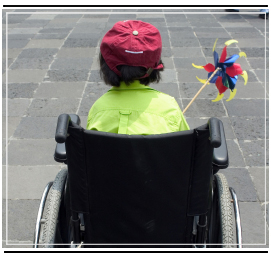
The "Nechim L'Ma'an Nechim" Project
Who understands a person of limited mobility better than someone else with limited mobility? Similar experiences, particularly similar suffering, draw people together. That's the principle behind the success of support groups in general. Support offered by one who understands the situation is very a great help indeed.
At Yad L'Neche we think that a person with limited mobility or other "handicap" is the best person to offer help to others who contend with similar challenges. One who copes with living with a disability can give more than emotional support to others in a like situation. He or she can give economic support, practical help and even physical assistance.
Thus, with a lot of hope and faith, we launched this project in which people with physical limitations help others who have similar difficulties.
And this is how it works…
Sam's story:
"I am classified, medically, as 100% 'disabled.' I'm pretty much glued to my wheelchair. I need help to do just about anything: eating, bathing, moving and more.
"For years I felt meaningless. What was I living for? For somebody? What does the world gain by the fact that Sam Cohen is sitting in his wheelchair looking out his window watching neighborhood kids playing ball?
"I wasn't depressed, but I was, usually, grumpy. I kept away from other people. Then, one day, Yad L'Neche came into my life with a bang, and turned everything upside down. A very intense fellow, a representative of Yad L'Neche, came to visit and introduced himself as 'Jakov'. We had a conversation that went something like this:
"Jakov: 'I need your help, Sam.'
"Me: 'I can't even help myself. How do you think I'm going to help you?'
"Jakov: 'Not me. A kid, a 15 year-old-boy who become crippled, because his left leg was just amputated.'
"Me (in shock): 'Amputated? Are you sure?'
"Jakov: 'Yes. I'll show you his picture if you want. He needs a good prosthesis that will enable him to return to his friends, his school, his life. The government is not paying for a prosthesis for him and neither is his HMO. His parents don't have a shekel. I need your help!
"Me: 'You've come for a donation?
"Jakov: 'Actually, no. I came to you to ask you to call people on this list that I'm giving you. Tell them about Jakov, and tell them about the 15 year old boy. Ask them to make a donation. Healthy people who walk on two legs will understand, maybe, that this child needs their help to walk at least on one healthy leg and one artificial leg.'
"You understand? I couldn't tell him 'No.' A child! Crippled like me! What, he should also sit in a wheelchair his whole life and watch other kids playing? No! No! I called people. I told them I can't walk, can hardly move. I asked them for a donation for this youngster whose leg was amputated.
"I think that when someone's heart is burning, it's possible to hear the flames through the telephone. People donated. A prosthesis was bought for the boy and I was happy. That boy got a prosthesis because of my work!
"After this effort, I was asked to raise money to help the mother of several young children. She suffered from a disability and urgently needed an expensive piece of equipment in order to function as a mother.
"Suddenly, I had a reason to get up in the morning. My life took on meaning!"
You get the idea. Sam's life turned around. He was happy because he was able to help someone else. The young amputee received a prosthesis and was able to return to his friends and his school. The young mother received the piece of equipment that enabled her to function and to take care of her children.
The "disabled" are helping others who need their help. And they are discovering that they have more abilities than they knew about before.
Job Match
Right now, Yad L'Neche is establishing a large communications system of computers and telephones in the homes of people who have limited mobility. The participants in this project happen to be good at communicating ideas and information. We've entered the matchmaking world, so to speak; we are matching employers with telephonists and others who will be working from home via computer and telephone.
The communications system costs half a large fortune, of course, and there are no public funds for this project. The great social – and eventually, economic – value of this project is clear. Put yourself, for a moment, in the place of someone who can speak well, even professionally, but cannot walk. The enormous value of our communications project suddenly becomes obvious, right?!
 YAS LANECEA